
Franchising can seem complex, but at its core it is a proven method for growing a business.
The term ‘franchising’ is used to describe many different kinds of business relationships. Most commonly, it refers to Business Format Franchising, which provides a replicable system for expanding your brand.
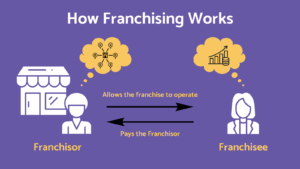
In Business Format Franchising, a company licenses its trademarks and proven business methods to others. In exchange, it receives a recurring payment, either as a percentage of gross sales or a fixed fee. A company that licenses its trademarks and methods is called a franchisor. An individual who pays to use a franchisor’s trademarks and methods is called a franchisee. Franchisees open clones of the franchisor’s business, and run them with the continual assistance of the franchisor for a pre-determined period.
For businesses considering franchising, understanding what franchisees receive is important. It helps you design a support system that ensures success for both parties.
How the Franchise Agreement Works
The relationship between a franchisor and a franchisee is governed by a contract called the Franchise Agreement. This agreement outlines the privileges, terms, conditions, restrictions and other details of the arrangement. The business operated under a Franchise Agreement is often called a franchise outlet or franchise location.
The Franchise Agreement typically entitles the franchisee to initial training, an Operations Manual, and a start-up package. It also provides a delineated area of operation (the “territory”) and ongoing support. In addition, it includes national and/or regional marketing support and the trademark licence. The Agreement entitles the franchisor to various payments and fees. It actively controls the trademark(s), how the products and services are marketed and sold, and the overall quality and standards of the business.
Benefits of Franchising
Franchising allows previously untrained people to own and operate a tried and proven business, and provides companies a profitable means of expanding. The benefits to both parties and to the economy as a whole are significant.
The Origins of Franchising
The origins of franchising can be traced back to the Middle Ages. However, it is generally recognised that the early 20th century saw the first real Business Format Franchise. This model was developed by Singer Sewing Machine Company in the United States. The company set up a service and maintenance system for its machines. General Motors was also involved in franchising later in the 20th century. It helped lay the foundations for a franchised motor dealership network. This system still predominates motor vehicle retailing to this day.
One of the most successful early franchises was the soft drinks bottling industry, where Coca-Cola, Pepsi and 7-Up initiated the use of franchising as an economic method of expansion for the sales and distribution of their brands. As the idea of franchising gathered further converts in the United States, so the number of franchisors grew: oil companies franchised their petrol filling stations and wholesalers franchised their retail grocery stores.
The 1950s saw an increasing interest in franchising and the concept was adopted by companies in ever increasing sectors of the economy. McDonald’s is today one of the best examples of Business Format Franchising. In 1960, the International Franchise Association (IFA) was founded in Washington, DC, with the aim of protecting, enhancing and promoting the interests of the franchising industry. The IFA is today the world’s oldest (and largest) franchising organisation and represents more than 1,500 franchise systems, 10,000+ franchisees and more than 500 firms supplying goods and services to the industry.
The British Franchise Association (BFA) was formed in the late 1970s to promote high standards in the industry and to educate the public about franchising.BFA accreditation gives credibility to franchisors offering reputable franchise opportunities.
How Franchising Works
Franchising is based upon a long-term business relationship between franchisor and franchisee. The franchisor has the proven business formula, method and model. The franchisee has the drive and wherewithal to use, follow and build a business. Successful franchising depends on collaboration, clear systems, and support – key elements for growing your brand efficiently.
These franchise types are common:
A Job Franchise – Small, self-contained businesses, often run by a single person. Frequently service-based or vehicle-based operations.
Sales & Distribution Franchise – Businesses that focus on selling and distributing products or services within a defined territory.
Management Franchise – Involves overseeing multiple units or operations within a region, usually managing teams and workflows.
Retail Franchise – Businesses with a physical presence, requiring premises, staff, and equipment. Consistency of product, service, and brand is important.
Food & Beverage Franchises – Businesses focused on selling food or drinks to consumers. Operations can include restaurants, cafes, or bars, and require attention to quality, training, and consistent customer experience.
Investment Franchises – Designed for owners who provide strategic oversight while others handle daily operations. Common in hotels, multi-unit restaurants, or other larger-scale ventures.
More definitions can be found in our Terminology in the Franchise Industry.
Further Information on How Franchising Works
In a nutshell that is how franchising works – do you want to dig a little deeper?
Perhaps you want to know more in terms of franchising your business? Find out more via our Why Franchise Your Business page.
Or perhaps you would like to do some further reading about how franchising works. Please see below for franchise websites and publications.
Franchise Websites and Publications
There is a wealth of information out there both online and in print, but where should you start? To learn more about franchising we highly recommend these websites and publications.
We Can Help You To Learn More About How Franchising Works
For more information on anything franchising related, call 0330 016 0028, email enquiry@ashtonsfranchise.com or complete our online enquiry form.